
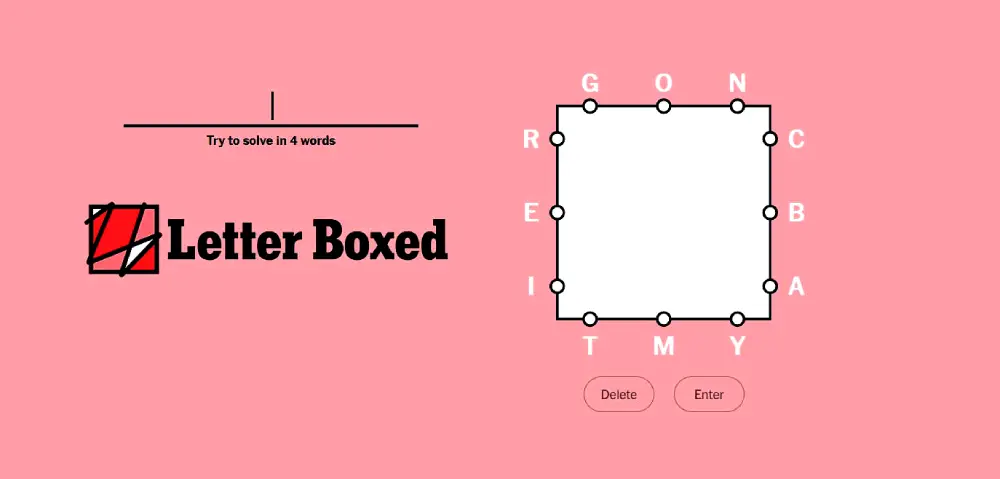

The New York Times has solidified its reputation as the king of the “daily habit” game. While Wordle gets the headlines and Connections sparks the most social media debates, there is a sophisticated, geometrically satisfying cousin in the NYT Games stable that deserves your attention: NYT Letter Boxed.
If you are a fan of anagrams, spatial reasoning, and expanding your vocabulary, Letter Boxed is likely already on your morning rotation. If not, you’re missing out on one of the most intellectually rewarding puzzles on the web. In this ultimate guide, we will break down everything you need to know about NYT Letter Boxed, from basic rules to the “Two-Word Solution” strategies used by the pros.
What is NYT Letter Boxed?
Launched in early 2019, NYT Letter Boxed is a word-building puzzle that challenges players to connect letters around a square to form words. Unlike a crossword where clues lead you to an answer, or Wordle where you guess a hidden word, Letter Boxed is an open-ended puzzle.
The goal is simple: Use every letter on the perimeter of the square at least once to form a series of words.
The Anatomy of the Square
- The Box: A square with three letters on each of its four sides (12 letters total).
- The Constraint: You cannot use two letters from the same side of the square consecutively.
- The Connection: The last letter of your current word must be the first letter of your next word.
- The Limit: The NYT sets a “Goal” (usually solving it in 4 or 5 words), but the ultimate bragging right is the “Two-Word Solution.”
How to Play NYT Letter Boxed: The Rules
Before diving into advanced strategies, let’s ensure the fundamentals are rock solid.
- Consecutive Letters: You can move from any side to any other side. For example, if the letter ‘A’ is on the top side, your next letter must be from the left, right, or bottom side. You cannot follow ‘A’ with another letter from the top side.
- Word Length: Words must be at least three letters long.
- The Relay: This is the trickiest part for beginners. If your first word is “CLIMB,” your second word must start with “B.”
- Winning: You win once every one of the 12 letters has been used in at least one word.
Why NYT Letter Boxed is Addictive
What makes NYT Letter Boxed stand out in the crowded field of digital puzzles? It’s the balance between freedom and restriction.
Unlike Spelling Bee, where you are hunted by the “Pangram,” Letter Boxed feels like a path-finding mission. You aren’t just finding words; you are building a bridge that covers 12 specific points. There is a profound sense of satisfaction when you find a long word that “clears” an entire side of the box in one go.
Read also this: ZZZ Banners
Pro Strategies for NYT Letter Boxed
If you find yourself consistently hitting 5 or 6 words but want to reach that elusive two-word maximum, you need to change your approach. Here are the strategies the experts use:
1. Identify “Tricky” Letters Early
Letters like Q, X, Z, J, and V are the “bottleneck” letters. If you see a ‘Q’, your immediate thought should be to find a ‘U’ on a different side. If you save these difficult letters for the end, you will often find yourself stuck with no way to connect them.
2. Hunt for Common Suffixes and Prefixes
Since the last letter of one word is the first of the next, ending a word on a versatile letter is key.
- Suffixes: Look for ways to use -ING, -ED, -TION, -OUS, or -LY.
- Versatile Endings: Ending a word with ‘S’, ‘T’, or ‘R’ opens up thousands of possibilities for your next word.
3. The “Two-Word” Mindset
To solve NYT Letter Boxed in just two words, you generally need two words that are 7–9 letters long.
- Scan for “Pangrams”: Look for a word that uses as many unique letters as possible. If you can find an 8-letter word that uses 7 unique letters, you only have 5 letters left to cover in your second word.
- Middle-Letter Pivot: If you find a great long word like “PHARMACY,” your next word must start with ‘Y’. Before committing to “PHARMACY,” quickly scan the remaining letters to see if a word starting with ‘Y’ (like “YESTERDAY” or “YOGA”) can pick up the slack.
4. Use “Filler” Letters Wisely
Remember, you can use the same letter multiple times. If you have a ‘T’ on the bottom and an ‘E’ on the left, you can bounce back and forth (T-E-T-E) if it helps you form a valid word like “TEETER.” This is a great way to “travel” to a different side of the box without using up new letters.
Common Pitfalls to Avoid
Even seasoned players of NYT games fall into these traps:
- The Same-Side Trap: You see a perfect word like “APPLE,” but then realize ‘P’ and ‘L’ are on the same side. Always double-check the sides before mentally committing to a word.
- Wasting the ‘S’: Many players use ‘S’ to pluralize a word early on. Often, that ‘S’ is better used as a starting letter for a difficult second word.
- Ignoring the “Check” Feature: The NYT interface will tell you if a word isn’t in their dictionary. Don’t be afraid to experiment with words you think might exist—the dictionary is surprisingly broad.
The Benefits of Playing Daily Word Puzzles
Engaging with NYT Letter Boxed isn’t just a way to kill time during a commute. Research suggests that word puzzles provide several cognitive benefits:
| Benefit | Description |
| Neuroplasticity | Challenging the brain with new patterns strengthens neural pathways. |
| Vocabulary Expansion | Letter Boxed often requires using obscure words to bridge letter gaps. |
| Problem Solving | It teaches you to look at a set of data (the letters) from multiple angles. |
| Stress Relief | The “flow state” achieved during puzzling can lower cortisol levels. |
Letter Boxed vs. Other NYT Games
How does it compare to the rest of the suite?
- Wordle: Wordle is about deduction and luck. Letter Boxed is about construction and visualization.
- Spelling Bee: Spelling Bee allows any combination as long as you use the center letter. Letter Boxed is much stricter due to the “sides” rule.
- The Crossword: While the Crossword tests general knowledge, Letter Boxed is a pure test of linguistic agility.
Frequently Asked Questions
What is a “Two-Word Solution” in Letter Boxed?
A two-word solution is the “perfect” score. It means you managed to use all 12 letters in just two connecting words. The NYT usually lists the “official” solution the next day, which is often a two-word pair.
Does NYT Letter Boxed have a dictionary limit?
Yes. Like Spelling Bee, it uses a curated dictionary. It generally excludes proper nouns, hyphenated words, and highly obscure technical terms.
Can I play past Letter Boxed puzzles?
If you have an NYT Games subscription, you can access the archives for certain games, though Letter Boxed is primarily designed as a daily challenge.
Is there a new Letter Boxed every day?
Yes, a fresh puzzle is released at midnight local time, alongside the rest of the NYT Games catalog.
Conclusion: Master the Box
The NYT Letter Boxed puzzle is a masterclass in elegant game design. It’s simple enough for a five-minute break but deep enough to frustrate and delight you for an hour. By focusing on tricky letters, planning your “relay” connections, and aiming for those two-word finishes, you’ll find your vocabulary and spatial reasoning improving daily.
For more related topics: https://mirsft.com/